
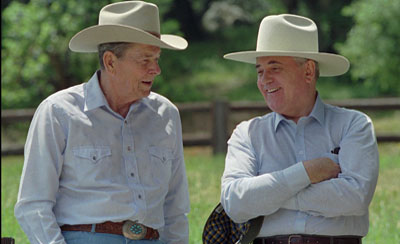
Ronald Reagan and Mikhail Gorbachev talk during a Gorbachev visit to Reagan’s Rancho del Ceilo home in California in May of 1992. (AP Wideworld/Bob Galbraith)
Kevin Drum, while defining what he considers to be “The Luck of the Gipper“, makes the following point:
4. Reagan eventually agreed to arms reductions with the Soviet Union, but that became possible only when two Soviet leaders in succession died after little more than a year in office and the reforming Mikhail Gorbachev came to power.
It’s obviously to Reagan’s credit that he seized the opportunity to work with Gorbachev, but he was still lucky to get the chance. If Konstantin Chernenko had remained in power for a few more years, that chance probably never would have come.
I also agree in part with Justin Raimondo who reinforces the case that Reagan posed a challenge to the hardliners congregating under the auspices of President Gerald Ford and then-CIA chief George H.W. Bush, who in their various capacities, “wrongly criticized and “corrected” the official estimates, always in the direction of enlarging the impression of danger and threat.” Unlike Raimondo, I don’t believe the Ronald Reagan who said, “If there has to be a bloodbath, then let’s get it over with,” (On what to do about student protests at UC Berkeley. Quoted in the San Francisco Chronicle, May 15, 1969.) would have vehemently protested ID Cards. Neither do I believe the man who covertly supplied arms to the Contras would have been entirely unmoved by post-9/11 rhetoric to reorder the Middle East. I think the following exposes the reactionary side of Reagan, a man who allowed his gut instincts to prevail, one who sought ambitious ends through means not so prudently measured.
On 03/01/04 Matt Bivens pointed to this David E. Hoffman article in the Washington Post describing what some have termed an episode of “cold-eyed economic warfare” against the Soviet Union in 1982. Thomas C. Reed, a long-time political associate of Reagan’s and former Air Force secretary who did a stint as the Special Assistant to the President for national security policy during Reagan’s administration, claims he obtained CIA approval to divulge details about the operation called Farewell Dossier and included it in his recently published book, “At the Abyss: An Insider’s History of the Cold War.”
“Farewell” was the code name for Col. Vladimir Vetrov, a 53-year-old engineer assigned to evaluate intelligence collected by a KGB section known as Directorate T, which was set-up in 1970 by the Soviet Union in order to steal technology secrets via its operating arm Line X. In 1981, when Reagan was informed by President Mitterand of France that Vetrov’s services had been obtained and the scope of his information revealed, a sting operation was executed substituting the real thing with technology geared for destruction that resulted in a three-kiloton gas pipeline explosion.
David E. Hoffman cites this paper by intelligence adviser to four presidents, Gus W. Weiss, a highly decorated civil servant who reportedly ended his own life by jumping from a window in his Watergate East residential building in Washington D.C. on November 25, 2003. The Iraq War was the first in his career he ever opposed. Weiss shared Reagan’s belief “that the USSR’s economy did not work and that the Soviet system was on the way to collapse”, wrote that Reagan’s “intuition led him to believe the Cold War could be won”, and that Reagan “enthusiatically” received his plan to slip the Russians bogus software.
According to Hoffman:
The sabotage of the gas pipeline has not been previously disclosed, and at the time was a closely guarded secret. When the pipeline exploded, Reed writes, the first reports caused concern in the U.S. military and at the White House. “NORAD feared a missile liftoff from a place where no rockets were known to be based,” he said, referring to North American Air Defense Command. “Or perhaps it was the detonation of a small nuclear device.” However, satellites did not pick up any telltale signs of a nuclear explosion.
“Before these conflicting indicators could turn into an international crisis,” he added, “Gus Weiss came down the hall to tell his fellow NSC staffers not to worry.”
Matt Bivens observes in this commentary, that had the Soviets assumed it to be a nuclear attack, “we’d have had about six minutes to convince them otherwise.”
Bivens notes here that two months after the Siberian gas pipeline explosion, the Soviets shot down Korean Air Lines 007, killing all 269 people on board. Despite briefings by the CIA and the NSA that “the Soviets might have thought they were shooting down a U.S. spy plane”, the State Department employed director Alvin Snyder to produce a propaganda film that would convince the U.N. Security Council that the Soviets had deliberately shot down the passenger plane. According to Snyder, “One Soviet journalist told me that our video was the biggest propaganda blow ever suffered by the Kremlin during the Cold War, something from which the Soviets never fully recovered.”
So despite the knowledge that the Soviet Union was floundering economically and militarily, and these spy games were now resulting in the death of civilians, the Reagan administration soldiered dangerously on in their disinformation campaigns poking the Soviets with the biggest sticks they could manufacture.
Was Reagan hoping the hornet would sting back or oblivious to the possibility? Would either conclusion be reflective of realist thinking?
About the time I met with Casey, Vetrov fell into a tragic episode with a woman and a fellow KGB officer in a Moscow park. In circumstances that are not clear, he stabbed and killed the officer and then stabbed but did not kill the woman. He was arrested, and, in the ensuing investigation, his espionage activities were discovered; he was executed in 1983. CIA had enough intelligence to institute protective countermeasures.
In 1985, the case took a bizarre turn when information on the Farewell Dossier surfaced in France. Mitterrand came to suspect that Vetrov had all along been a CIA plant set up to test him to see if the material would be handed over to the Americans or kept by the French. Acting on this mistaken belief, Mitterrand fired the chief of the French service, Yves Bonnet.(6)
But the final word belongs to Snyder:
Flight 007 was a victim of the Cold War, and it proved that war could be very real and could lead to human casualties. Another casualty, always war’s first, was the truth. Anything that worked was fair game. The story of Flight 007 will be remembered pretty much the way we told it in 1983, not the way it really happened. Technology may well spawn disinformation more insidious than any we have yet known. What replaces 1980s-style disinformation in the future may make it seem wholesome by comparison, and the press must be ever more vigilant.