
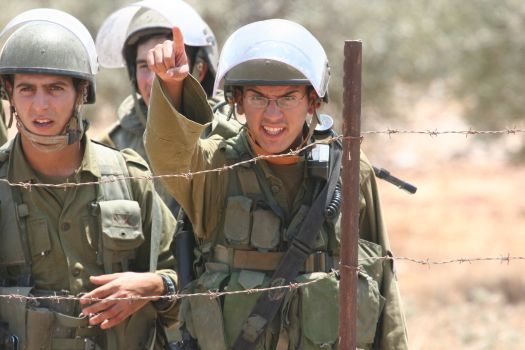
Bil’in: A Struggle in Pictures
Israeli soldier shouts at demonstrators who began to move into a farmer’s field alongside the barricade.
Photograph © copyright Jon Elmer 2005. For reprint permission, please contact The New Standard.
“I was ashamed of myself the day I realized that I simply enjoy the feeling of power. Not merely enjoy it, need it. And then, when someone suddenly says no to you, you say: what do you mean no? Where do you get the chutzpah from to say no to me? Forget for a moment that I think that all those Jews are mad, and I actually want peace and believe we should leave the Territories, how dare you say no to me? I am the Law! I am the Law here! Once I was at a checkpoint, a temporary one, a so-called strangulation checkpoint blocking the entrance to a village. On one side a line of cars wanting to get out, and on the other side a line of cars wanting to get in, a huge line, and suddenly you have a mighty force at the tip of your fingers. I stand there, pointing at someone, gesturing to you to do this or that, and you do this or that, the car starts, moves towards me, halts beside me. The next car follows, you signal, it stops. You start playing with them, like a computer game. You come here, you go there, like this. You barely move, you make them obey the tip of your finger. It’s a mighty feeling.'”
Breaking the Silence: Israeli Soldiers Reflect on Patrolling Hebron
Yitzhak Laor
London Review of Books, V26, N.14, on July 22, 2004.
I’ve added a link | graphic to the sidebar on the right. The image is part of an exhibition that opened in Tel Aviv College in early June 2004, organised by the photographers who are “mostly unnamed conscripts who served in Hebron“.
Sixty of the 90 photos record aspects of the conflict between the Palestinians and the settlers, but 30 show the soldiers at their daily routine — and the routine tells all. Indeed, towards the end of June, the IDF’s military police raided the exhibit, “confiscating,” as Haaretz put it, “a folder containing newspaper clips about the exhibit, as well as a videotape including statements made by 70 soldiers about their experiences in Hebron.” Four of the young men who organized the exhibition were called in for interrogation. What were they interrogated about? Well, they are suspected of having committed the crimes they documented on their video — abusing Palestinians, destroying property, etc.
I became aware of the exhibition when viewing “Occupied Minds“, a documentary produced and directed by Jamal Dajani, a Palestinian-American who is Link TV’s Director of Middle Eastern Programming and producer of MOSAIC: World News from the Middle East, and by Link TV’s co-founder and Director of Current Affairs David Michaelis, an Israeli citizen. Both men were born in Jerusalem. The film is an invaluable resource that provides often startling revelations of personal and state machinations driving the conflict.
“According to (pdf) Mr. Dajani, ‘Occupied Minds captures both the physical and mental occupation that Palestinians and Israelis on the front line experience daily through their fears, apprehension and suspicion. It is not the discourse or narrative of foreign journalists and pundits with no connection to the land or the people. Rather, it IS the story of the land and its people.’
Adds Mr. Michaelis, ‘we hope our film will decode for American viewers the true narratives of the people—narratives hiding behind the simplistic slogans of Israeli and Palestinian politicians that are circulated widely in the media.'”
“Breaking the Silence” (“Shovrim Shtika“) is the website/forum of the former conscripts who organised the “Breaking the Silence- Fighters Tell about Hebron” exhibit. Their continuing investigation now includes hundreds of new testimonies.
We began to investigate, interview and document hundreds of former combat soldiers. All this was done under guarantee of full confidentiality to all those who contact us in order to testify. The amount of testimonies we have gathered proves time and again that it is not a matter of “exceptional cases” or “stray weeds”. It is a dangerous phenomenon growing from day to day. Things that were once exceptional have become the norm. Israeli society must know the price it is paying for every soldier serving in the occupied territories. Israeli society must realize the trap we are caught in, because while the army is trying to deal with the threat posed by terror, it is creating a disaster.
We are discharged soldiers who have decided not to keep silent. To stop keeping to ourselves everything we’ve been through in the past 3 years. So far, hundreds of discharged combat soldiers have decided to break the silence and every day more people follow.
During our combat service we’ve handled many different missions. We have one mission left: to talk, tell and not keep anything hidden.
“Breaking The Silence” (“Shovrim Shtika” in Hebrew) should serve as a warning sign to Israeli society. We are alerting about irreversible corruption.
Partners for Peace is a non-profit that for 10 years has “sought to educate the American public about key issues in the effort to secure peace and justice in the Middle East”. They organise the “Jerusalem Women Speak: Three Women, Three Faiths, One Shared Vision” project whose FALL 2005 tour will take place October 14-29 and go to Iowa, Texas, Colorado, Virginia, Maryland, Pennsylvania and Washington DC. Speakers from the Summer 2005 tour interviewed by Amy Goodman on Democracy NOW! on July 18, 2005 included Michal Sagi, a Jewish Israeli who is active with Machsom Watch, a group founded in January 2001 by and for Israeli women for the purpose of monitoring checkpoints and establishing a presence, or intervention if necessary, that might dissuade soldiers from abusing Palestinians.
When I read on Breaking the Silence’s site that their work “should serve as a warning sign to Israeli society. We are alerting about irreversible corruption.”, I was reminded of remarks Michal Sagi made to Goodman, which follow:
AMY GOODMAN: There is a movement in the United States on college campuses to cut off — call for the cut-off of aid to Israel, stop doing business with companies that do business with Israel. As the Israeli here, Michal Sagi, what is your response to that? Do you support that?
MICHAL SAGI: We Israelis, and I am Israeli, part of the Israeli society, care deeply for Israel and its future, and this is exactly why I’m doing what I’m doing. I’m very pro-Israeli. I’m not pro the policy, but I’m very pro-Israeli. So I know that it’s going to be very hard for Israel if countries and companies will start boycotting us. But I think that we need a certain amount of pressure to go forward. We need a third party to get involved, but in a fair way.
AMY GOODMAN: What do you mean “but in a fair way?” What about the role of the U.S. right now?
MICHAL SAGI: “In a fair way” means to acknowledge the rights of Palestinians and to negotiate eye to eye, on eye-level, not to patronize, not to decide for the other what is good for them, but to really sit around a round table, and not otherwise. Obviously, the States is more towards the Israeli policy. And I’m —
AMY GOODMAN: Meaning the United States?
MICHAL SAGI: Yes. I’m not using the terminology of being — they’re not being pro-Israeli, because again, I am not — I don’t think that this is pro-Israeli. I think that it harms Israel. Continuing the occupation is destroying Israeli society. It’s harming us severely. We’re corrupting a second and third generation by occupying another nation. And by the way, I think it’s going to happen to you, as well, if — but that’s again, a different story.
AMY GOODMAN: Meaning?
MICHAL SAGI: Meaning, you cannot occupy a civil society and control a civil society and stay human and stay democratic and stay good human beings.
AMY GOODMAN: And you’re talking about?
MICHAL SAGI: Iraq.
AMY GOODMAN: The U.S. occupation of Iraq?
MICHAL SAGI: Yes.
At this point I was going to offer my opinion about United for Peace and Justice’s declaration that many Americans are incapable of absorbing nuanced information in a timely manner, and rather than embrace every opportunity to educate whomever it is they feel would be distressed by antiwar activists representing Palestinian’s right of return at the demonstration this September, UFPJ will support a narrow slip of causes approved by some pollster.
That’s PR not P & J.
But now I find there’ll be something resembling commingling after all.
Statement about a
joint rally and joint march
for September 24
The two major antiwar coalitions that have initiated and organized for a massive antiwar March on Washington for September 24 have agreed to organize a joint rally followed by a joint march. Both coalitions will organize under their own banners, slogans and with their own literature for the September 24 demonstration. The joint rally will begin at 11:30 am at the Ellipse in the front of the White House. We urge everyone around the country to unite and come out for the largest possible antiwar demonstration on September 24.
There is an overwhelming torrent of resources begging to be claimed and made available to teach the most hardened of souls about the horrors of occupation, and here’s a so-called peace and justice organisation banishing it from the realm for fear of “alienating” the complacent and complicit who make the occupations possible.